

AWS PrivateLink is available on Enterprise plans. Contact your Revyl
account team or [email protected] to enable it for
your organization before you start.
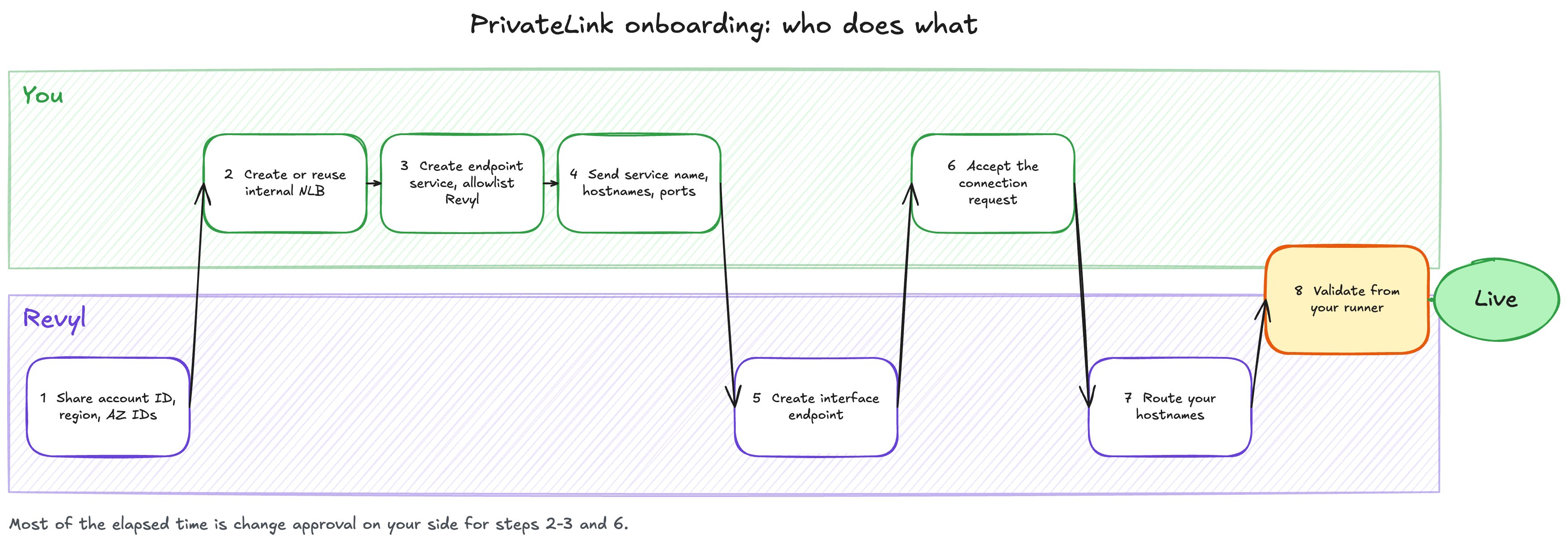
Before you start
You need:- An AWS account and VPC that can reach the private service.
- Permission to create Network Load Balancers, target groups, and VPC endpoint
services (
elasticloadbalancing:*andec2:*VpcEndpointService*), or someone on your infrastructure team who has it. - The hostname and port of each service Revyl should reach, for example
artifactory.internal.example.com:443. - PrivateLink enabled for your Revyl organization, which requires an Enterprise plan. Reach out to your account team or [email protected] to enable it.
1
Note Revyl's connection details
You need these values in the steps below:
2
Create an internal Network Load Balancer (optional)
Already have an internal NLB in front of the service? Reuse it. Check it
against the list below, fix anything that does not match, then go to step 3.
- Scheme: internal.
-
Subnets: for a service in
us-west-2, include a subnet inusw2-az2, plus your usual zones. Match on AZ ID, not AZ name. In another region, use at least two zones; no zone matching is needed. See Regions and Availability Zones. -
Cross-zone load balancing: on. In
us-west-2, Revyl enters only throughusw2-az2. With cross-zone off, only yourusw2-az2targets serve Revyl, and Revyl’s traffic is blackholed whenever that zone has no healthy target. See Cross-zone load balancing. -
Listener: TCP on the service port, usually
443. A TCP listener passes your service’s TLS through untouched. A TLS listener with an ACM certificate also works if you prefer to terminate TLS on the NLB. - Target group: your instances, IPs, or an Application Load Balancer, with a health check that reflects real service health. Fronting an ALB adds its own zone behaviour; see Fronting an Application Load Balancer.
- Security groups: if your NLB has a security group, turn off Enforce inbound rules on PrivateLink traffic. With it on, the security group sees the private IP of Revyl’s client, not an address in your VPC, so a rule that allows only your VPC CIDR blocks Revyl. Connection acceptance and the principal allowlist already limit who can connect. If your policy requires enforcement, ask Revyl for its source range and allow the listener port from it. Your targets’ security groups must allow traffic from the NLB.
3
Create the VPC endpoint service
Publish the NLB as an endpoint service and allow only Revyl’s principal.
- AWS console
- Terraform
- AWS CLI
- Open VPC -> Endpoint services -> Create endpoint service.
- Load balancer type: Network. Select your new or existing NLB.
- Require acceptance for endpoint: on.
- Supported Regions: add
us-west-2only if your service is in another region. - Private DNS name: leave unset. Revyl maps your hostnames on its side.
- Create the service, then open its Allow principals tab and add
arn:aws:iam::992382537093:root. - Copy the Service name. It looks like
com.amazonaws.vpce.us-west-2.vpce-svc-0123456789abcdef0.
4
Send Revyl the service details
Send the following to your Revyl contact. Nothing here is secret.List every hostname your builds or app will use for these services, including
redirect targets and CDN-style download hosts. Revyl’s gateway denies any
hostname that is not on your list.
Onboarding details
5
Accept Revyl's connection request
Revyl creates the interface endpoint and tells you its endpoint ID. Accept the
pending request.The connection state moves from Pending acceptance to Available
within a few minutes.
- AWS console
- Terraform
- AWS CLI
Open your endpoint service -> Endpoint connections. Confirm the
Owner is Revyl’s account ID,
992382537093, and the Endpoint ID matches the one Revyl
sent, then choose Actions -> Accept endpoint connection request.6
Validate together
Revyl maps your hostnames to the endpoint and runs a connectivity check from
your Revyl capacity. Then run a real job: a build that pulls a private dependency, or a test that calls
your private API.See Verify and troubleshoot for what to
check on your side.
Adding more services later
- Same NLB, new port: add a listener and target group, then send Revyl the new hostname and port. No new endpoint is needed.
- New hostname on an existing port: traffic lands on that port’s existing
target group. Use this only when the backend already routes by hostname, for
example by HTTP
Hostheader or TLS SNI. Otherwise give the service its own port. Then send Revyl the hostname. - New NLB: create a second endpoint service and repeat steps 3-5. Do not attach it to the existing endpoint service: when an endpoint service has several NLBs, AWS picks one per endpoint network interface, not per hostname, so every NLB on a service must serve the same listeners and backends.